|
From
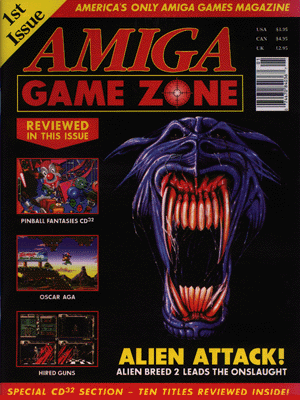
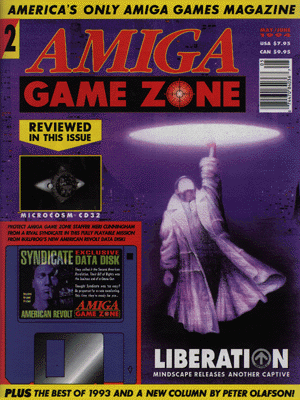
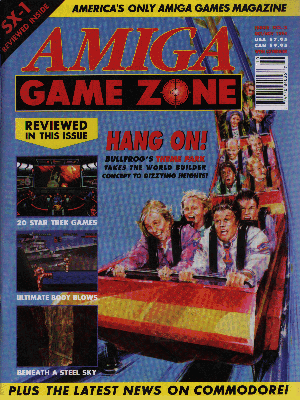
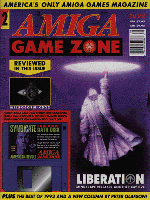
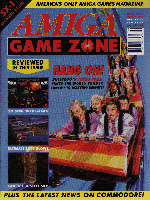
1994 to 1996, I published a nationally distributed magazine in
addition to being a full-time graduate student in the advertising
program at the University of Illinois. Amiga Game Zone was
a 48 page bi-monthly publication that catered to a niche market
of computer game enthusiasts. Each issue contained industry news
and product reviews as well as a cover-mounted floppy disk with
playable previews of upcoming games. The magazine was sold throughout
North America at hundreds of book and computer stores including
Barnes & Noble, Hastings, and Tower Records. This was a time before the rise of new gaming systems from Playstation, XBOX and Nintendo.
Bzzzzzt... Reality check. We're not exactly talking Time magazine
here, folks. Amiga Game Zone had a base of only around 1,000
subscribers, with an additional 4,000 copies of each issue printed
for newsstand distribution. And I'd have to perfect Obi-Wan Kenobi's
Jedi mind trick in order to make anyone believe that I actually stuck
to a bi-monthly schedule – I only published three issues of the
magazine in a year. Far from being a household name, I can't even begin
to tell you how many times the magazine had been mistakenly referred
to as Omega Game Zone, Amigo Games, or (my favorite) Amiga
Gonzo.
I also sold computer games directly through the magazine, and I employed
a few students to help me answer the phones and process orders. Although
we affectionately called it "the spacious mid-town office," all
the work was done out of my house in Urbana, Illinois. Early one morning
a subscriber phoned in with the request, "Do you have Monkey Island
II?" My comatose brain processed the question as "Who am
I talking to?" and I replied, "Oh, this is Geoff." (The
moral of the story is not to answer the phone next to the bed at 7
o'clock in the morning no matter how coherent you think you will sound.
Believe me, it won't foster repeat business.)
But the magazine's relatively small scale was part of the attraction
for me. It was large enough that I could realize a small profit, yet
not so demanding that it controlled my life. And publishing your own
magazine did have its perks. One was that you got to make up your own
title. My official job description was head head of the many-headed
hydra that was Amiga Game Zone. I designed every page of the magazine;
I wrote some of the articles and edited the rest; I handled all the
public relations, marketing, and advertising; and, most importantly,
I got to play a lot of computer games. Being in charge of so many areas
did lead to some problems, though. It was hard to pressure the art
director into finishing a layout for the editor when you were the art
director as well as the editor. But I loved having complete control
over a project, from deciding the type of paper stock to use for a
promotional flyer to listening to a reader beg, "I'd run somebody
over in a car to get a copy of Mortal Kombat II."
The best part of this situation was that I was been able to use my
academic experience to supplement my publishing venture and vice versa.
I learned a great deal about publishing schedules, project coordination,
media buys, and magazine design by actually experiencing them first
hand. Thanks to the elaborate computer network provided to students
by the university, I was been able to use the Internet since 1989 – and
I started utilizing the World Wide Web to market my magazine in 1994.
I was also able to apply my publishing and design experience to specific
problems in my graduate courses.
I feel that the advertising graduate program at the University of Illinois
developed my strategic thinking to a much higher level. My greatest
accomplishment in graduate school was the realization that I actually
knew less when I received my master's degree than I thought I did when
I received my bachelor's degree. And, of course, that I should always
let the answering machine pick up before 9 a.m.
See what I'm up to now at IdiotSavant.com or view my resumé
E-mail your comments
to Geoff Miller at miller@idiotsavant.com
|
full size image (61K)
full size image (71K)
full size image (87K) |